
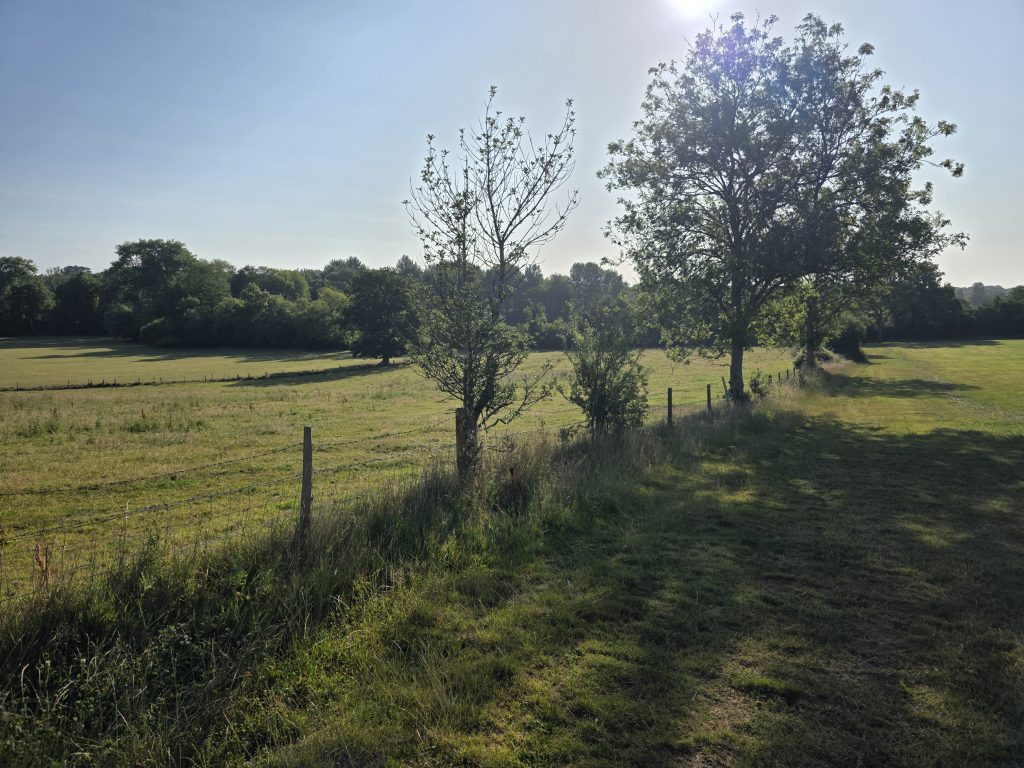
This morning, I stood by a fence in the quiet of a sunlit field. It was early. The air still held a touch of coolness, and the light was just right – the golden sort that makes everything look a little more magical than it really is. A row of trees lined the field, each casting long shadows over the grass. The fence itself was simple: wooden posts with wire stretching from one to the next, marking out the edges of the land. Man-made, yes, but settled so long ago that it felt almost natural. And as a children’s writer that’s what got me thinking.
As a children’s writer, I’m constantly navigating boundaries. Some of them are like this fence, necessary, helpful even, showing you where you are and where you might go next. Others are less welcoming, more like walls than fences, shutting you out or hemming you in. Some boundaries you build yourself, others are built around you. And if you’re not careful, they can become more than just lines in the landscape; they can become limits.
Boundaries as a Children’s Writer
Children’s books, at first glance, are full of boundaries. There are the obvious ones: word counts, reading levels, age brackets. There are stylistic boundaries: no swearing, no violence (at least, not without consequences), no long-winded metaphors or dense paragraphs. There are moral boundaries too, often unwritten, but always felt. In many ways, these boundaries are good. They give shape to a story. They make it safer, more accessible, especially for young readers who are only just finding their way through the world of words. Like a fence around a field, these boundaries say: “Here is your space. You can play safely within it.”
But just like in life, some boundaries in publishing feel arbitrary, outdated, or simply unhelpful. They aren’t fences keeping danger out; they’re barriers keeping voices in. As someone navigating both traditional publishing and self-publishing, I’ve seen both sides of the field. Traditional publishers have their criteria, their formulas, their lists of what sells and what doesn’t. If your story doesn’t fit neatly into a box, it may not get through the gate at all.
That’s why I turned to self-publishing. For me, it wasn’t just about control, though I’ll admit, there’s something wonderfully freeing about choosing your own cover design, setting your own price, writing what you want without someone telling you it’s ‘not quite marketable enough.’ It was about removing some of those artificial boundaries and seeing what could grow in the field beyond. Self-publishing gave me the space to take risks, to explore different styles, to write the kind of books I would have loved as a child, even if they don’t tick every traditional box.
That said, I’m still hunting for the right publisher. Not because I want to abandon self-publishing, but because I believe in hybrid paths. I believe a story can belong both inside and outside the fence. The right publisher, I hope, won’t see boundaries as walls, but as lines to sketch around and sometimes redraw. A good editor doesn’t just enforce the rules, they help you question them, stretch them, even break them where necessary.
Story Boundaries
Boundaries exist in stories too, of course. In fact, they’re often what stories are about. Think of all the fairy tales that begin with a line that mustn’t be crossed: don’t go into the forest, don’t open the door, don’t talk to strangers. These boundaries are both real and symbolic. They give children a sense of structure, of what’s safe and what’s risky. But the story really begins when the character steps beyond the line. That’s when the magic happens.
As a children’s writer, I want to do the same. I want to give young readers a story that feels safe and solid, like the field behind a fence, but I also want to offer them a gate. A chance to step beyond, to ask questions, to wonder what lies just outside the frame. Because childhood is full of invisible boundaries, many of which are never explained. And stories can help children explore those boundaries safely.
Sometimes, the boundaries I face aren’t external at all. They’re inside me: fear, doubt, perfectionism. That little voice that says, “That’s a silly idea,” or “No one will want to read that.” These are the hardest boundaries to overcome because they aren’t marked with posts and wire. They sneak up on you, whispering limits when you’re just about to leap. But they can be overcome. And writing, especially writing for children, is one of the best ways I know to do it.
Children don’t see fences the same way we do. They climb over them, peek through them, imagine entire kingdoms on the other side. A boundary, to a child, is not the end of something; it’s the beginning. And that’s the mindset I try to bring to every page. Yes, I respect the structure, the guidance, the craft. But I also stay curious. What happens if the character crosses the line? What if the rules are different in this world? What if the fence is actually a bridge?
When I look at the image I took today, the sun slanting through the trees, the fence winding away into the distance I see not a barrier, but a path. A direction. A signpost that says: here is one way, but not the only way. And that’s how I see this journey as a children’s author. There are many paths, many fences, many fields. Some you’ll be invited into, some you’ll have to climb into yourself, and others you’ll build from scratch.
Whether I’m publishing myself or knocking on publishers’ doors, I carry that image with me. I remember that even man-made boundaries can soften with time, can become part of the landscape. And I remind myself that the most important thing is not which field you’re in, but that you keep walking, keep writing, and keep sharing the view.
So if you’re a writer staring at a fence today – whether it’s a rejection letter, a blank page, or your own inner critic – take heart. That fence might not be the end. It might just be the start of your next adventure.
Until next time, Matt

Leave a Reply