

How Wilbur Smith Opened the Door to Big Adventures, Bold Characters, and the Kind of Stories My Dad Read Until I Pulled Them Off the Bookshelf for Myself
When I look back at the books that shaped me as a writer, some feel obvious. The childhood classics, the school reading, the authors everyone reads when they’re young. But every now and then, there’s a book that makes its way into your hands without anyone intending it to, and it stays with you.
That book, for me, was When the Lion Feeds by Wilbur Smith.
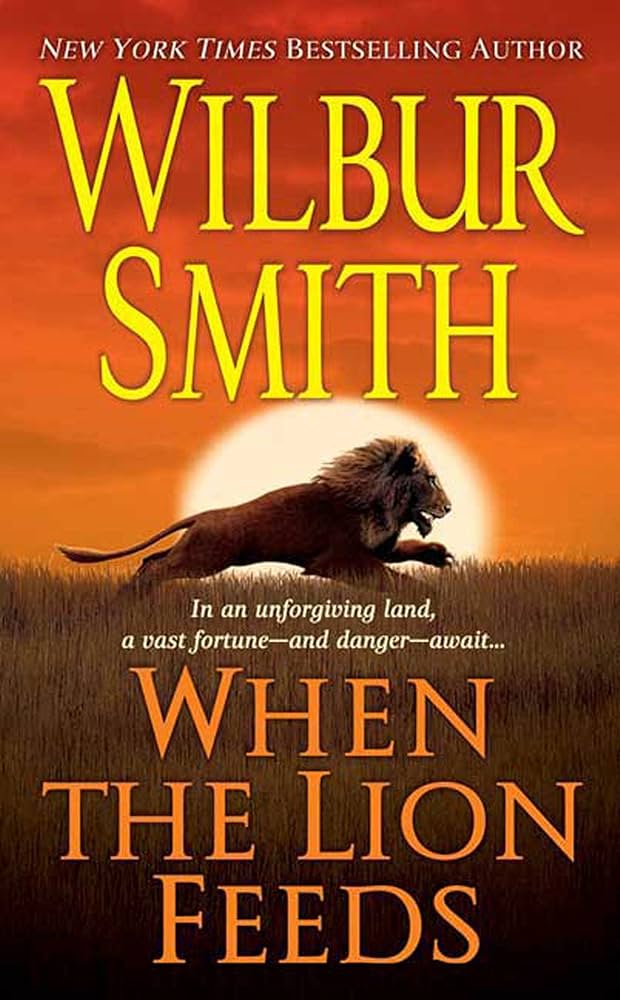
I was about ten or eleven years old when I first pulled it from my dad’s bookshelf. I still remember the distinctive red cover. I had no idea what the story was about, only that it felt different. Bigger. Older. A book for grown-ups.
And it was. But that didn’t stop me. I started reading it in secret, tucked under covers or hidden away when no one was looking. I don’t think Dad ever knew I was reading it. Not then.
That moment changed everything.
My Father, the Reader
Before I say more about Wilbur Smith, I need to say something about my dad.
My father loved to read. Always. Right into his eighties, he could lose himself in a novel just as easily as he could sit with a newspaper or a crossword. There were always books in the house growing up. They were part of the furniture, stacked on shelves, bedsides and kitchen counters.
He didn’t read children’s books, of course. He read grown-up books. Thrillers, histories, action-packed epics, and tales of Africa. And Wilbur Smith was one of his favourites.
At the time, I didn’t understand why that mattered. But now, looking back after his passing in February 2024, I realise that his love of books was a gift. One of the most lasting gifts he ever gave me.
The fact that he was always reading made it seem normal. Expected, even. It wasn’t something special in our house. It was just what people did. And because of that, I did it too.
When the Lion Feeds – My First Taste of Big Adventure
I didn’t know what to expect when I opened When the Lion Feeds. All I knew was that the cover looked like something adults read, and that made me want to read it even more.
Inside, I discovered something entirely different from the world of Enid Blyton or C. S. Lewis. This wasn’t a neat little mystery or a gentle stroll through a magical forest. This was Africa. Harsh. Raw. Real. Full of danger and beauty and history and blood.
The writing gripped me. It didn’t hold back. It was fast-paced, immersive, and filled with bold characters who made bold choices. I didn’t understand every detail at that age, but I felt the rhythm of the story. The sweep of the land. The danger in the shadows. The weight of family, ambition and war.
Sean Courtney was a revelation. A man of strength and flaws, who carried the kind of complexity that few characters in the books I’d read so far ever had.
I didn’t know it then, but I was reading one of the earliest influences on how I would come to view storytelling.
Africa Comes Alive
Of course, when I first read Smith, I had never been to Africa. I couldn’t imagine it, not really. The descriptions in the book painted a vivid picture, but it still felt like fiction to me.
What I didn’t know—what I couldn’t know—was that a few years later I would end up living in South Africa.
It’s strange how life works. As a child in England, reading about dusty plains, river crossings, gold mines and tribal lands, I never imagined I’d one day walk those same landscapes. That I’d breathe that same air, hear those same languages, and fall in love with the place.
South Africa became a part of me. Not just a chapter in my life, but a central thread. I got to know the country—and the continent—better than most people ever do. I didn’t just visit. I lived it. I worked in it. I listened to it.
And with every real experience I had in Africa, the words of Wilbur Smith came rushing back. They weren’t fiction any more. They were real. He had captured something in his stories that I could now feel for myself.
There’s a magic to Africa. A rhythm. A spirit. A wildness that refuses to be tamed and a beauty that defies description. Smith didn’t just write about Africa. He understood it. He lived it. And he passed that understanding on to his readers.
Africa in My Blood
It’s hard to explain to someone who hasn’t lived there, but Africa gets into your blood. It’s not something you can ever shake. The colours are brighter, the sounds are sharper, and the stories—oh, the stories—are everywhere.
That is what Smith gave me. Not just tales of Africa, but a way of seeing. A way of noticing the tension between progress and tradition, the dance between violence and peace, the contrast of wealth and poverty, and above all, the resilience of the land and the people who call it home.
That understanding now lives in my writing. Even when I’m not writing about Africa directly, the influence is there.
It’s in the scale of the adventure. The grit of the characters. The weight of history and consequence. And sometimes, the wild unpredictability of nature.
I like to think that, just as Smith captured the spirit of Africa through his Courtney novels, I channel some of that same untamed energy into Space Ranger Fred. It’s a very different setting, of course, but that raw sense of wonder, danger, humour and heart—it’s there. And Africa is part of it.
Storytelling with Purpose and Pace
One of the things Wilbur Smith did so well was balance pace with purpose.
His books move. There’s always action, always tension, always something just around the corner. But they are not hollow. The characters grow. The stakes matter. The landscape isn’t just a backdrop; it’s a force within the story.
As a writer, that taught me a lot.
You can have an exciting plot, but it needs to mean something. You can write a character who punches and fights and wins battles, but if they don’t grow, if they don’t feel loss or wrestle with decisions, they become empty. Smith knew how to make adventure fiction that had soul.
And that is no small feat.
In my own work, especially when writing for younger audiences, I try to carry that same balance. To tell stories that are fun and funny and fast, but also rooted in something meaningful. Whether it’s about friendship, courage, loss or responsibility, the story should matter.
A Writing Style That Grows With You
When I was ten or eleven, I was probably far too young to be reading Wilbur Smith. But I didn’t care. And, to be honest, I don’t regret it. His writing, while certainly adult in parts, never felt inaccessible.
As I grew older and revisited his books, I found new layers I hadn’t noticed before. That’s the sign of a good author. The stories grow with you. You understand more. You see the craft, the nuance, the historical weight and the emotional detail.
Smith wasn’t just writing adventure. He was writing legacy. He built generations of characters, crossing centuries, continents, and causes. The Courtney family alone spans over a dozen novels and several historical eras.
For a young boy reading in secret, that was just exciting. For a man reflecting as a writer, it’s inspiring.
A Tribute to My Father
My dad didn’t know I was sneaking his books at the time. He might have laughed if he had caught me. Or maybe he would have handed me another one and said, “Start here instead.”
He loved Smith’s stories for the same reasons I do now. They were exciting, well written, and grounded in something real. They didn’t need dragons or time machines or magic portals. The world was wild enough.
I wish I’d spoken more with my dad about the books we both loved. I wish I had told him, back then, how much I admired the way he always had a novel nearby. But I like to think he knew.
When he passed in February 2024, one of the things I found myself thinking about most was his bookshelf. The books he read. The stories he loved. And how many of those he passed on to me, sometimes without even knowing it.
What Wilbur Smith Taught Me as a Writer
Here’s what I take from Wilbur Smith into my writing every day:
- Adventure must be earned. It is not just noise; it has consequence.
- Characters must be bold, but also broken in places.
- The setting is part of the story. Let the land shape your plot.
- History matters. The past is always present.
- Pace must not sacrifice depth. You can move quickly without rushing.
- Legacy lives in layers. Let your story carry weight.
Smith never wrote with a wink or a nod. He was serious about his storytelling. And even if some critics brushed him off as “commercial” or “mass market”, his impact is undeniable. His books sold in the millions, and for good reason. They spoke to people.
They spoke to me.
Thank You, Wilbur Smith
Thank you for When the Lion Feeds, the red cover that started it all.
Thank you for stories that were bigger, bolder, and braver than anything I’d read before.
Thank you for making Africa real to me before I had ever stepped foot on the continent.
Thank you for showing me that you can write popular fiction that still has depth, character and craft.
Thank you for helping me connect with my dad, both then and now.
Your words travelled across generations and continents. And now, they live on in mine.
Coming Next in the Series:
How The Big Joke Game by Scott Corbett taught me that humour and imagination are not just fun, but vital ingredients in storytelling.
Stay tuned.
About the Author
Matt Newnham is a British children’s author, speaker and creative thinker. He is the author of Space Ranger Fred, Princess & Chicken, and other titles that entertain, inspire and spark young imaginations. His work draws from a lifetime of reading, writing, travel and deep appreciation for the books that shaped him. 📍 Based in the UK | ✉️ matt@mattnewnham.com | 🌐 www.mattnewnhamauthor.com
📸 Instagram: @mattnewnhamauthor
