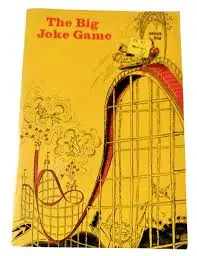
The Books That Made Me Write – Part 6 How The Big Joke Game by Scott Corbett Taught Me That Humour and Imagination Are Not Just Fun, But Vital Ingredients in Storytelling
I have just returned from a well-deserved break in St Ives, Cornwall. Ten days of sea air, pasties, long walks, and no deadlines. It was exactly what I needed after months of writing, editing, planning and preparing the next Space Ranger Fred book for release. It reminded me of the importance of rest, of stepping away from the page in order to return to it with fresh eyes and renewed joy.
Childhood Reading Memories and Comic Discovery
During the holiday, I also had time to think. Not just about what I’m writing now, but about where my love for writing began. I’ve been reflecting a lot lately, diving into the books that helped shape me into the writer I’ve become. The latest in this series takes me back to a lesser-known, but deeply loved, childhood book: The Big Joke Game by Scott Corbett.
This was not a book I had to read. It was a book I wanted to read. Again and again. It wasn’t a bestseller in the UK, and even today, it doesn’t have the name recognition of Dahl, Blyton or Lewis. But in my world, it was legendary.
And it was funny.
That’s what I remember most. I laughed. And in laughing, I learned something about the kind of stories I would one day want to tell.
First Encounters With Humour in Print
As a child, I was a keen reader. Narnia taught me to dream. Enid Blyton taught me the power of adventure. Roald Dahl showed me how to be cheeky, bold, and brave. But The Big Joke Game was one of the first books that made me laugh out loud.
It wasn’t just a chuckle or a smile. It was proper, eyes-watering, roll-off-the-bed kind of laughter.
This was a book that didn’t just use humour as a side element. It was the whole point. And yet it still had structure, heart, and characters you rooted for.
It showed me that humour is not a gimmick. It’s a craft. And when done well, it can be as moving, as memorable, and as meaningful as any drama or epic.
At the time, I didn’t think about it in those terms, of course. I just knew I loved it. But looking back now, I can see that Corbett’s writing planted something in me. A love of mischief. A respect for comic timing. And a belief that laughter and storytelling belong together.
Who Was Scott Corbett?
Scott Corbett was an American author who wrote dozens of books for children from the 1950s to the 1980s. He’s probably best known for his “Trick Series”, a string of humorous stories involving potions, accidental magic and chaos. The Big Joke Game follows a similar formula: take an ordinary setting, add one absurd premise, and then follow the results with glee.
Corbett’s books were smart. They didn’t talk down to children. His characters had real motivations. The humour wasn’t slapstick for the sake of it. It came from the situation, the dialogue, and the relationships.
And crucially, the adults in his stories were never perfect. Often, they were confused, misled, or the butt of the joke. That reversal of power – putting kids in the driving seat – is a theme that stuck with me.
What The Big Joke Game Is Really About
At its core, The Big Joke Game is a lesson wrapped in laughter.
The story follows Ozzie Hinkle, a boy who lives for two things: jokes and board games. He cares little for anything else, especially not the feelings of those around him. His humour is constant, relentless, and often poorly timed. But Ozzie doesn’t see the harm. He just wants to be funny.
That changes when he takes a fall and wakes up in a strange place – a sort of comedic limbo that is itself a living board game. The game world is built entirely around humour. Every challenge, every obstacle, every interaction is shaped by puns, limericks, riddles and spoonerisms. To progress, Ozzie must participate. Joke, pun, rhyme and twist his way forward.
But instead of simply delighting in the madness, Ozzie is paired with a companion he names Bub – short for Beelzebub – who acts as a sort of sarcastic, devilish guide. Bub seems to encourage the jokes at first, but slowly, subtly, things begin to shift.
As Ozzie travels through this surreal game world, moving two steps forward and three steps back, he begins to hear other people joke about him. He’s no longer the instigator. He becomes the target. He begins to realise how words can sting, how humour has edges, and how even a joke told in fun can land poorly.
What begins as a celebration of silliness becomes something more profound.
By the time he reaches the final space – FINISH – Ozzie has undergone a transformation. He hasn’t lost his love for humour. But he’s learned when to joke, and when not to. Bub, who now reveals himself to be a guardian angel rather than a devil, sends Ozzie back to the real world, a little wiser and a lot more thoughtful.
It’s a simple story, little over a hundred pages, but it packs a surprising punch.
I first read the entire book in one sitting, sometime in childhood. I’ve read it again as an adult. And I’ll be honest – it holds up. It’s still funny. It’s still clever. And more importantly, it still says something that matters.
Why This Book Stuck With Me
As someone who now writes humour-driven stories, I look back on The Big Joke Game and realise just how ahead of its time it was.
We live in a culture that often misunderstands humour. Some people fear it, worrying that it will offend or alienate. Others use it as a weapon, hiding behind “just a joke” to excuse cruelty. What Corbett managed to do – long before social media or cancel culture existed – was show children that humour is powerful. And with power comes responsibility.
Ozzie doesn’t become boring at the end. He doesn’t stop being funny. He becomes aware. He learns that jokes land differently depending on the listener. That empathy matters, even in laughter. And that humour, used well, connects people. Used poorly, it isolates them.
That’s an idea that has stayed with me throughout my life and career. I still believe that children love to laugh, and that they should. But I also believe that laughter is most meaningful when it brings people together, not when it singles them out.
The Big Joke Game taught me that. Gently, cleverly, and with a wink.
And for that, I’ll always be grateful.
Coming Next in the Series
Coming Next in the Series
How epic quests, sorcery, and a touch of dry wit led me to discover the world of David Eddings.
Stay tuned.
About the Author
Matt Newnham is a British children’s author and storyteller. He is the creator of Space Ranger Fred, Princess & Chicken, and a growing list of imaginative adventures designed to spark young minds. His books blend humour, heart and heaps of curiosity – all shaped by the books he loved as a child.
Based in the UK | matt@mattnewnham.com | www.mattnewnhamauthor.com Instagram: @mattnewnhamauthor

Leave a Reply