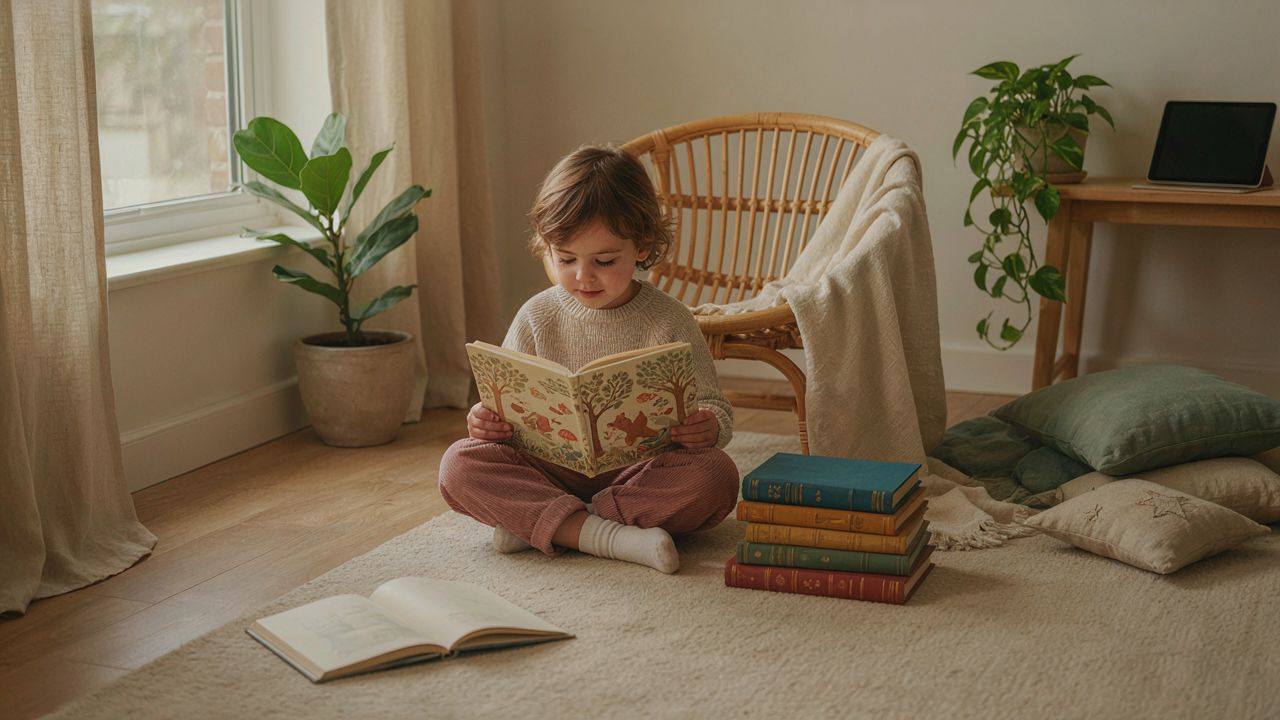
An iPad offers instant games, videos and educational apps, while a physical book asks your child to slow down and focus. That difference explains why books are better than an iPad for your child in many daily situations. Tablets can support learning when adults choose good content and set limits, but books offer clear benefits for attention, language, sleep, movement, imagination and family connection. The best screen time alternatives for kids do not need to reject technology. They make books a steady part of family life.
Why books are better than an iPad for your child
Books create a calmer reading space with fewer distractions. They also give children physical clues that help them follow and recall what they read.
Physical books reduce digital distractions
A book has no alerts, adverts, autoplay videos, games or competing apps. Its pages do not invite a child to click away from the story. This can help children follow events in order and finish a reading session.
Create a reading basket or low shelf with suitable books. Keep the iPad in another room while your child reads, so the book has their full attention.
Print reading can support comprehension and recall
A peer-reviewed systematic review of 23 studies involving pupils aged 6 to 18 found mixed results. Some studies showed no clear difference between print and digital reading, while others found better comprehension on paper, especially with longer or harder texts.
A book’s page position, thickness and familiar layout can give children concrete memory cues. Print is not best for every child or task, though. Age, reading skill, design quality and adult support all affect the result.
A daily 15 to 20-minute reading period can build independence. Let your child choose from several suitable titles, mark finished books on a paper chart, and keep reading material within easy reach.
Books strengthen language, imagination and critical thinking
Reading with an adult gives children more than words on a page. It creates time to talk, predict, question and connect ideas.
Books expose children to richer language
Picture books, poetry, chapter books and non-fiction introduce words and sentence patterns that may not appear in daily speech. Reading Rockets explains how reading aloud builds vocabulary, background knowledge and comprehension skills.
When a new word appears, pause and explain it in plain language. Link it to something your child knows, then ask them to use it in a fresh sentence. The quality of the book and the talk around it matter more than whether the words are printed or digital.
Stories invite imagination instead of delivering every detail
A book may show one illustration and leave children to create the voices, sounds and movement. Highly animated tablet content can provide those details through music, narration and effects, leaving less room for the child to fill gaps.
Ask, “What do you think the character is thinking?” or “What could happen next?” You can also ask how the ending might change if the character made a different choice. These small questions build prediction, reasoning and creative thought.
Why books are better than an iPad for your child’s bedtime
A physical book offers a practical way to end the day without more alerts, autoplay or stimulating content. It also gives bedtime a clear beginning and end.
Books offer a screen-free bedtime routine
The NHS advises keeping tablets, phones and laptops away during the 30 to 60 minutes before sleep because screens and their content can interfere with settling down. Its guidance on sleep and young children also supports a calm, predictable routine.
Turn screens off, dim the lights, and read one or two short books together. Finish with the same phrase or song each night. This repeated pattern helps your child recognise that sleep is close.
Physical books make limits easier to keep
Tablet content often has no natural stopping point. A book does: the end of a story, page or chapter gives children a clear transition.
Try a visual timer, a “one story before bed” rule, or a book-choice ritual. Reading is still sedentary, so pair it with outdoor play, stretching, craft work and household tasks during the day. Books can reduce screen use, but they cannot replace movement.
Books create stronger parent-child connections
Shared reading is a relationship activity as much as a literacy activity. The physical format makes it easy for two people to share one focus.
Reading together builds shared attention
Sit beside your child, hold the book between you, point to details and pause for comments. Your child can hold the book, turn pages, name pictures and retell a familiar story.
The American Academy of Pediatrics recommends shared reading from birth because it supports language, social-emotional growth and close relationships. These benefits come from the warm back-and-forth exchange, not from handing over a book and walking away.
Books help children understand emotions and relationships
Stories give children words for fear, anger, friendship, loss, courage and change. Choose books that reflect your child’s life while also showing different families, cultures, abilities and points of view.
Ask, “Why do you think the character made that choice?” Try, “What would you do here?” Other useful prompts include, “What clues show how the character feels?” and “How is this like something in your life?” Make room for an answer without pressing your child to share something personal.
Books give parents more control over what children read
Physical books still need care. They can contain frightening, misleading or unsuitable ideas, so adults should check them before sharing.
Parents can preview and curate books easily
Read reviews, scan the illustrations and check themes before buying or borrowing a title. Librarians, teachers, literacy groups and publishers can help you find books that match your child’s age and interests.
Books avoid many tablet-specific concerns, including adverts, data collection, recommendations, in-app purchases and distracting links. The AAP’s digital media guidance recognises useful digital content but also warns that autoplay, endless scrolling and targeted adverts compete for children’s attention.
When a tablet is needed, disable notifications, use a child profile and content filters, remove unnecessary apps, set a time limit, and watch unfamiliar content together.
A personal library builds ownership
Choosing, borrowing, sorting and caring for books helps children see themselves as readers. Rotate titles on a shelf, group them by topic, and let your child choose books at the library.
Public libraries, used bookshops, book swaps, school fairs and community literacy schemes can keep costs low. Write your child’s name and the date inside a few favourite books to create a keepsake collection.
Books work best when they are accessible and shared
The goal is not to remove every device. It is to make reading easy, enjoyable and regular.
Choose books that match your child’s interests
Animals, vehicles, sport, music, fantasy, science and humour can all draw a reluctant reader in. Comics, graphic novels, non-fiction, audiobooks paired with print, and repeated picture books all count.
Let children leave a book that is unsuitable or dull and try another. Enjoyment helps reading become a habit, rather than a task linked only to school.
Adapt reading to age and ability
Babies and toddlers often enjoy board books, rhymes, repetition and picture naming. Preschool children benefit from picture walks and prediction questions, while early readers may need shared reading, phonics practice and short solo sessions.
Older children can choose chapter books, non-fiction and longer discussions. Children with dyslexia, visual impairments, attention differences or other needs may benefit from audiobooks, large print and digital accessibility tools alongside physical books.
Build a family media plan around sleep, activity, schoolwork, relationships and reading. Try “books alongside screens” rather than using reading as a punishment. When adults read paper books themselves, children see reading as a normal part of home life.
Conclusion
Physical books support sustained attention, language, recall, imagination and shared conversation. They create calmer bedtime routines, clearer screen limits and a visible path towards independent reading. Tablets still have a place when content is carefully chosen, time is limited and an adult stays involved.
Choose one appealing book today, put the iPad away and read together for 15 minutes. For a child’s growing mind, a book is more than a screen-free alternative – it is a space to focus, imagine, connect and grow.

Leave a Reply